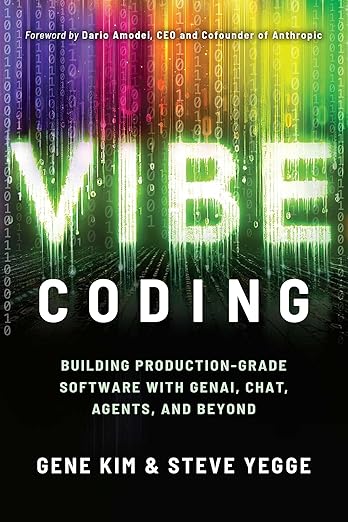
I don’t like the term “vibe coding.” I strongly prefer “AI-assisted software engineering.” But regardless of what you call it, Gene Kim and Steve Yegge have written a book about it - and their journey from skeptics to true believers is the most interesting part.
Two Converts
Here’s what grabbed me: both authors expected to hate AI coding tools. Steve Yegge, with 19 years at Google and Amazon, was a skeptic. Gene Kim, WSJ bestselling author of The Phoenix Project, wasn’t exactly an early adopter. And now? They’re both all-in. That conversion story is more compelling than any marketing pitch.
Who Will “Get” This Fastest
Here’s my take that you won’t find in other reviews: anyone with Lead Engineer or Manager experience who was still in the thick of coding will pick up these techniques much faster than the folks who craft every line by hand and love the nuances of their language.
Why? Because the neural pathways are already set. You’ve spent years learning to delegate, to set direction and let others execute, to verify results rather than control every keystroke. Managing an AI agent feels natural when you’ve managed humans. You already know how to give clear intent, break down problems, and review output.
The devs who obsess over whether to use a ternary operator or an if statement? They’ll struggle more. Not because they’re less skilled - often they’re more skilled at the craft. But the mindset shift is harder when you’ve never had to trust anyone else with your code.
The Book Itself
The book covers their disasters and wins. There’s a story about “The Vanishing Tests” where an AI silently deleted 80% of test files. There’s something called “The Eldritch Horror Code Base” where code devolved into a 3,000-line function. The Register found it “repetitive in places” but the honest failure stories add credibility.
They introduce frameworks like the “Head Chef Mindset” and something called “FAAFO” (Faster, Ambitious, Autonomous, Fun, Optionality). The extended kitchen metaphor gets tiresome, but the core loop is solid: frame objective → decompose tasks → test/verify → iterate.
The Naming Problem
Simon Willison makes a fair point: the term “vibe coding” was coined by Andrej Karpathy to describe throwaway weekend projects where you “forget that the code even exists.” The book’s subtitle is “Building Production-Grade Software” - which is exactly what vibe coding is not supposed to be.
This semantic debate matters. Addy Osmani argues that “vibe coding is not an excuse for low-quality work” and he’s right. If you want to be taken seriously, call it what it is: AI-assisted engineering with guardrails.
Who Should Read It
If you’re already using AI coding tools and want to formalize your approach, this gives you frameworks and mental models. If you’re a technical leader trying to figure out how to scale this across teams, the enterprise section might help. Dr. Erik Meijer compared it to McConnell’s Code Complete - high praise if it lands for you.
If you’re still skeptical of the whole thing, there’s plenty of valid criticism out there about hidden bugs, technical debt, and skill erosion. Those concerns are real. The authors actually acknowledge them - they warn that “reckless abandon leads to chaos and endless pager calls.”
Conclusion
The book isn’t perfect. The “vibe coding” branding is a misstep. But the core message - that experienced engineers can and should treat AI as a capable junior developer who needs clear direction and verification - that rings true.
And the conversion story? Two seasoned veterans who went from skeptics to believers? That’s worth paying attention to.
I’ve made the same journey. I’m deep down this rabbit hole!