I’ve been thinking a lot about excellence lately. Not the motivational-poster kind. The real kind – the kind that gets baked into your bones when you’re twenty-two years old and surrounded by people who simply will not accept anything less. For me, that happened on a nuclear submarine.
The Nuclear Power Program: Where “Good Enough” Doesn’t Exist
I was in the US Navy at the tail end of the cold war. I served on the USS Richard B. Russell, SSN-687. We were a “special projects” submarine based out of Mare Island, California (in the San Francisco Bay Area). I left the services as an E-6, ET1(SS) qualified as a Nuclear Reactor Operator and Engineering Watch Supervisor.
Let me start with some context. To work on the engineering plant of nuclear submarine, you have to survive the Naval Nuclear Power Program. This is the pipeline Admiral Hyman G. Rickover built, and it is no exaggeration to call it one of the most selective and demanding training programs in the world. It’s formal technical training in a specialized skill first (mine was electronics, but could have been mechanical systems or electrical systems), followed by Nuclear Power School (NNPS). It’s equivalent to a 2 year highly technical degree jammed into six months, followed by another six months operating an actual reactor at a prototype training unit. The washout rate is real. Probably a third of my class failed out. The standards are absolute. You either know the material cold or you don’t. There is no grading on a curve. There is no “close enough.” A nuclear reactor doesn’t grade on effort.
This program produced a culture – a culture where rigor isn’t optional, where accountability is personal, and where Excellence is the standard. A culture that shaped who I am. Still. All these years later.
The Submarine Force: Elite Within the Elite
But the nuclear program is just the entry ticket. The submarine force itself is another level entirely.
The baseline qualification level on a submarine is higher than almost anywhere else in the military. The submarine service is also all-volunteer – you cannot be involuntarily assigned to a boat. Everyone there chose to be there. Not everyone stays.
Once you’re aboard, you spend your first year “qualifying in submarines” – learning every system on the boat from stem to stern. Reactor plant, weapons systems, sonar, navigation, damage control, hydraulics, electrical – all of it. You have to be able to draw systems from memory. You have to know where all the damage control equipment and emergency breathing air hose manifolds are - blindfolded. By touch. You get quizzed by anyone senior to you, any time, anywhere. The process requires that a fully qualified submariner personally sign your “qualification card” for every single item of knowledge. And there are a lot of items.
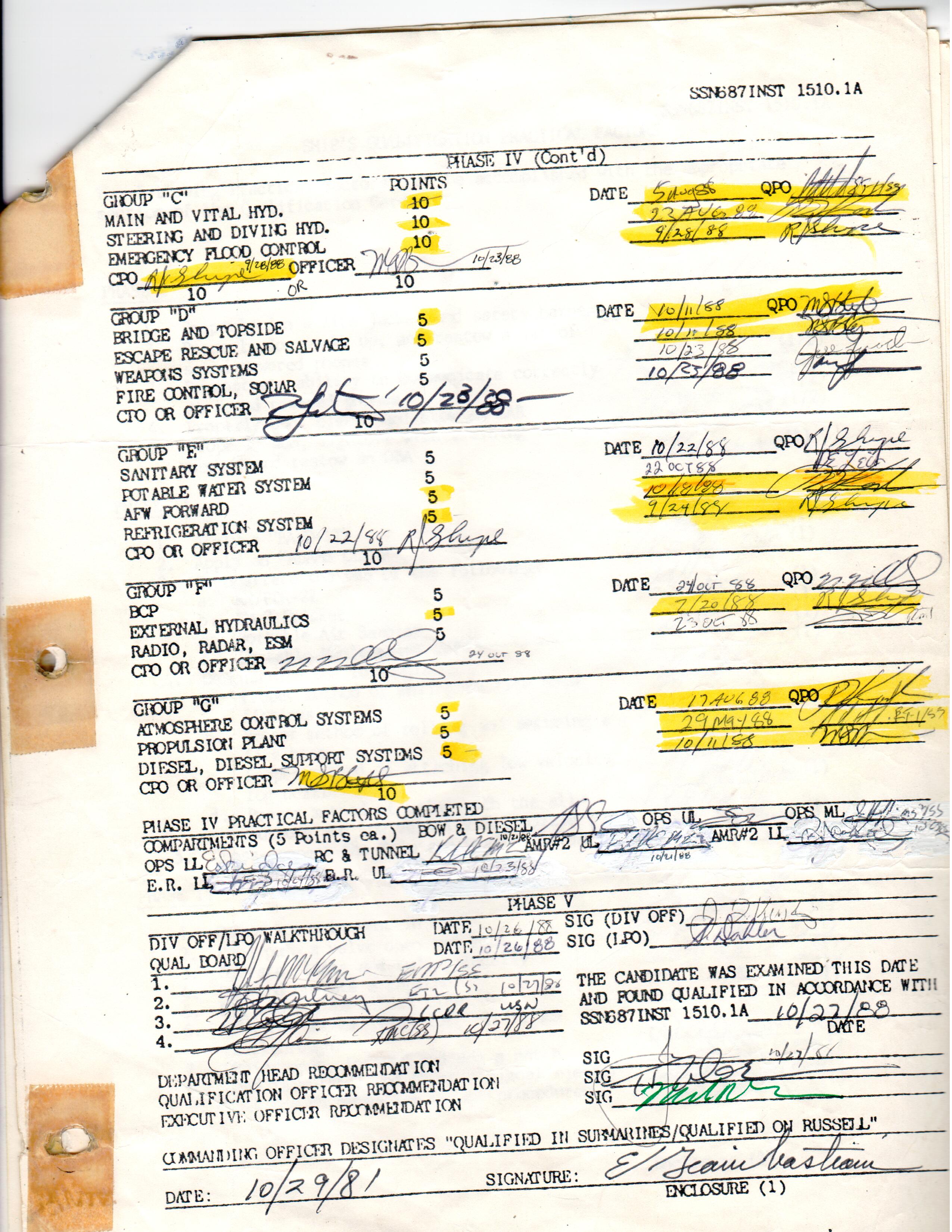
The last page of my submarine "qual card."
When you qualify, you can pin on the coveted “Submarine Dolphins” which are the submarine force special warfare insignia. If you want to stay in submarines, you have to qualify. If you can’t, you are gone. Transferred somewhere else, not in submarines. If you are wearing Dolphins, you earned them. There are no exceptions. It means the crew trusts you with their lives, because on a submarine, one person’s mistake can kill everyone. Or conversely, you alone may be the person whose quick thinking and actions saves the ship and the crew. It’s literally life or death.
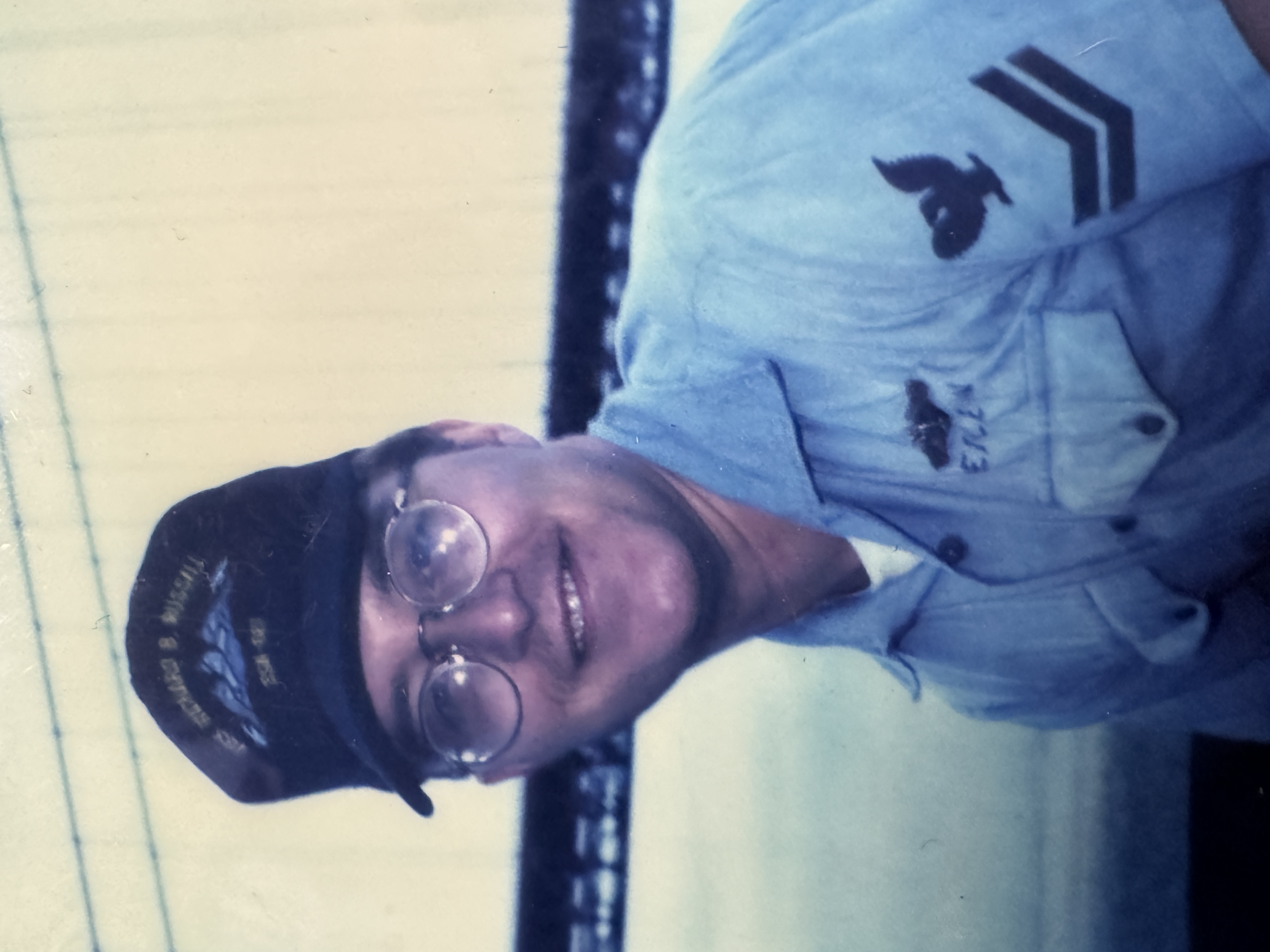
I had my dolphins presented to me on the surface as we came under the Golden Gate Bridge.
Submarines operate independently, often with no communication for extended periods. There is no calling for help. The crew has to be self-sufficient, technically brilliant, and psychologically resilient – all while living in a steel tube smaller than most people’s houses - but with 126 other people. The submarine force has historically produced a disproportionate number of flag officers and senior leaders relative to its small size. It’s a leadership factory, and the Russell was no exception.
Two Commanding Officers, Two Extraordinary Careers
I served on the Russell from 1987 to 1991, and I had the privilege of serving under two commanding officers who went on to careers that still stagger me when I think about them.
Admiral Edmund P. Giambastiani Jr.
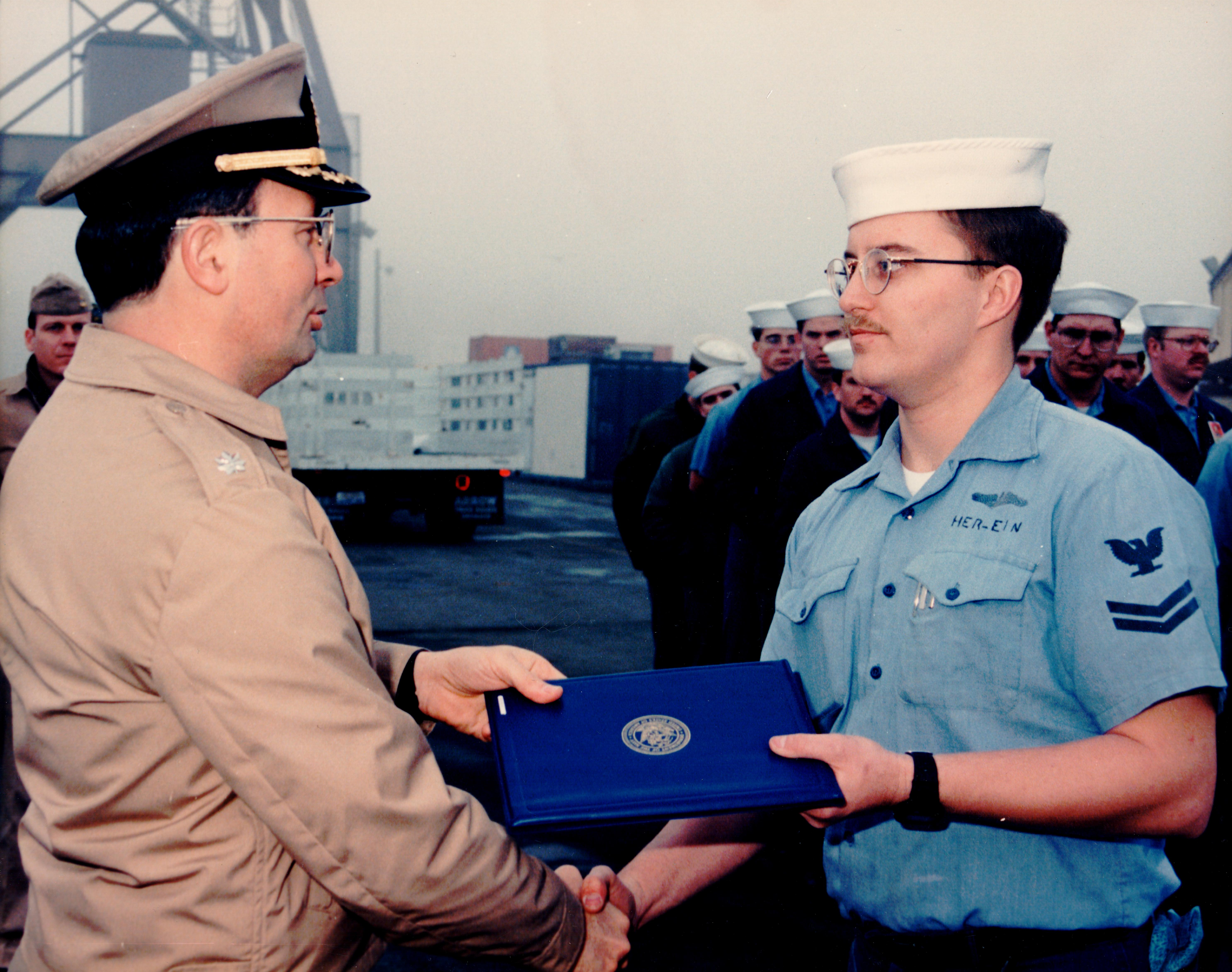
Captain Giambastiani presenting me with an award on the Russell.
Captain Giambastiani commanded the Russell and drove us to three consecutive Battle Efficiency “E” awards, three Navy Unit Commendations, and two Fleet Commander Silver Anchors for excellence in retention.
Before the Russell, he’d commanded NR-1 – the Navy’s only nuclear-powered deep submersible research submarine. Where did he go after the Russell? He commanded Submarine Development Squadron Twelve. He led all Atlantic submarine forces. He served as Senior Military Assistant to Secretary of Defense Donald Rumsfeld. He became NATO’s first Supreme Allied Commander Transformation. And then he became the Vice Chairman of the Joint Chiefs of Staff – the second-highest-ranking military officer in the entire United States.
Let that sink in. The guy who stood on the bridge of my submarine pinning my dolphins onto my uniform went on to become the number two military leader in the country. A four-star admiral.
Vice Admiral Charles L. “Chuck” Munns
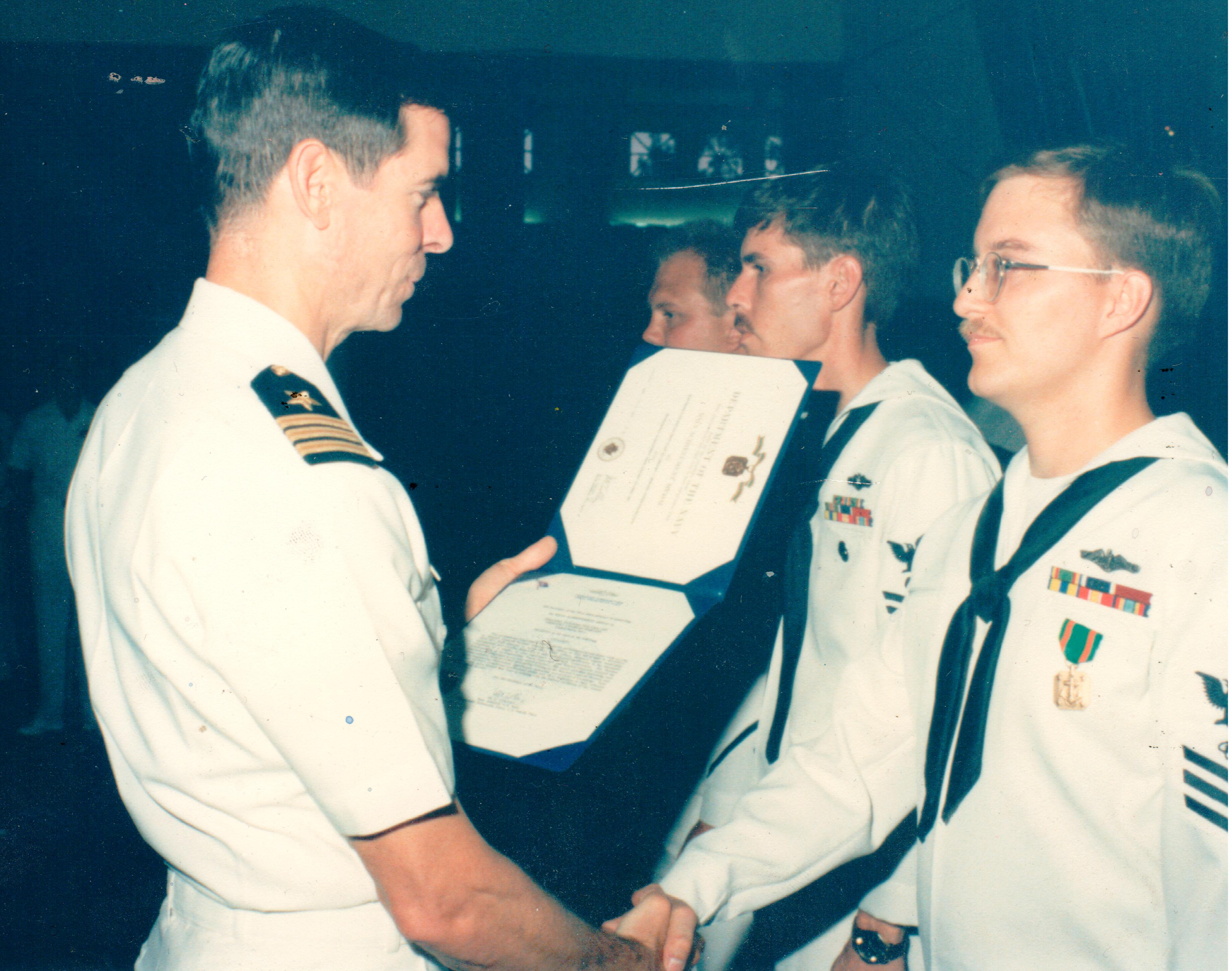
Captain Munns presenting me with an award on the Russell.
Captain Munns took command of the Russell in April 1990 and led us through the period that earned the boat a Presidential Unit Citation. A physicist by training (Naval Academy, then a Master’s in Computer Science from the University of Colorado), he brought a sharp analytical mind and a quiet intensity that made you want to be better just to not let him down. To this day, if he asked for my help he’d get it. No questions asked.
After the Russell, Captain Munns commanded Submarine Development Squadron Twelve – the same elite command Giambastiani had led. He went on to command Submarine Group 8 in Naples, Italy, overseeing all submarine operations in the Mediterranean. And then he reached the top: Commander, Naval Submarine Forces – the officer in charge of every submarine and submariner in the United States Navy. A three-star Vice Admiral running the entire submarine fleet.
Two commanding officers of the same boat. One became Vice Chairman of the Joint Chiefs. The other became Commander of all submarine forces. That doesn’t happen by accident.
The Standard That Never Left
I think about these men often. Not because they were distant, untouchable leaders – but because they weren’t. They were right there. On the deckplates. In the engine room. In the control room at 3 AM during an exercise when they could have been in their stateroom. They set the example by being present and by being relentless about getting it right.
Both were extremely human as well. Captain Giambastiani would stop in the engineering spaces to talk to me about HAM radio. Captain Munns was extremely kind when I had a family issue. They weren’t just excellent at being a military leader. They cared deeply about their team.
But it wasn’t just the COs. It was everyone. The chiefs who wouldn’t let you take a shortcut. I still hear the words of ETCM(SS) Dahler, MMCM(SS) Dix, MMCM(SS) Shupe, ETCM(SS) Ashton in my everyday life. Even in the little things, like never leaving a coffee pot empty. Even the first-class petty officers who knew their systems better than the manuals who simply demanded that you know as much as they did. I was proud to be one of them before I left. The junior guys who pushed each other because nobody wanted to be the weak link on a crew like that. And yes, a few that we didn’t keep because they could not make the cut. The Russell was a special boat with a special crew, and the culture of excellence was everywhere.
What I am Left With
When you spend your formative years in an environment like that, it changes you permanently. You develop an internal standard that never goes away. Every job I’ve had since, every team I’ve led, every piece of software I’ve built – somewhere in the back of my mind is the Russell. Somewhere in the back of my mind is Captain Giambastiani’s expectation, Captain Munns’s precision, the Chief’s eagle eyes… and the knowledge that the people around me on that boat gave everything they had, every single day. We had to. It was life or death.
I can only aspire to live up to it. I spent four years surrounded by people who showed me what excellence actually looks like – not as an abstraction, but as a daily practice. Two of them went on to lead the most powerful military in the world. The rest of them went on to lives and careers shaped by the same uncompromising standards.
That’s the thing about real excellence. You don’t learn it from a book or a seminar. You learn it from being around people who embody it, in an environment that demands it, doing work where the stakes are real. I was lucky enough to find that on the USS Richard B. Russell. Everything I’ve done since has been an attempt to honor what I learned there.
I can only hope that I’ve been able to create a bit of that everywhere I’ve been.