In recent years, digital signage has become a solved problem: push content to screens reliably, at scale, on schedule. That’s not enough anymore. The market is now demanding screens that perceive — that understand what’s in front of them and respond in real time. Most of the hardware deployed in the field today will fail at that job because the foundational assumptions are wrong. Here’s what’s actually required and why the infrastructure choices you make now will define your deployment for the next decade.
I’ve seen all the computer technology changes for the last 30 years - since PC data storage was on cassette tapes. My first hard drive was a whopping 5 MEGAbytes and cost $800. I actually owned an Osborne. I learned C using Borland Turbo C on a 286. I’ve done tech a long time.
When I got into digital signage in 2004, I inherited a deployed system that used HD-ATSC playback into cable TV modulators and I was tasked with modernizing that system - I architected and oversaw the development, deployment and operation of the Walmart Smart Network - at the time the most advanced retail advertising network in the world. In 2009 I bought and deployed thousands of BrightSign players into retail advertising - because they were the best product I could find on the market. I went on to lead teams that built one of the the first SmartTV-based video content recognition systems at Cognitive Networks (later Inscape, bought by Vizio) - literally it was a vector database for video frames. I later managed the development of Cisco’s Infinite Video platform, and after that I was on the team at AWS helping customers learn to use live WebRTC video - the same technology that powers Slack Huddles. I have a LOT of experience with building, deploying and operating video systems.
Finally, I’ve spent the last four years as VP of Software at BrightSign, building the core technologies of today’s digital signage. So when I tell you that the shift happening right now in digital signage is real and different, I mean it. This isn’t a fad. This is a revolution.
Here’s the short version: For two decades, digital signage was a broadcast problem. You built infrastructure to push content to screens reliably, at scale, cheaply. That problem is largely solved. The new problem — the one the market is actually asking for now — is making screens respond to what’s in front of them in real time. That requires continuous AI inference running locally on the device. And almost every platform currently deployed in the field — PCs, Android, Windows, Samsung Tizen — will fail at that job. Structurally. Not because the vendors didn’t try. Because the hardware and OS assumptions are wrong from the foundation up.
Part 1: The Problem
The Shift Nobody Saw Coming (That Everyone Can Now See)
The original hard problem in digital signage was logistics. Getting the right content to the right screen at the right time, at scale, with acceptable reliability, across geographies with wildly different network conditions. That is genuinely hard engineering. The industry solved it. More or less. Tooling has vastly improved. Bandwidth got cheap so web technologies came into play. Content management platforms now address practically every niche that needs screens. Seriously, there are hundreds.
But here’s the thing — all of that is solving a broadcast problem. One sender, many receivers. Content goes out, screens show it. That’s a complete model if a screen’s only job is to play a video loop on schedule. It may be somewhat target by location, but it’s a playback loop.
It’s an incomplete model if a screen’s job is to understand what’s happening in front of it and respond intelligently. This shift — from scheduled to situational, from broadcast to responsive — is what I mean by moving from playback to perception. And that’s exactly what the market is demanding now. Not someday. Now. Because with Edge AI, it’s now cost-effective.
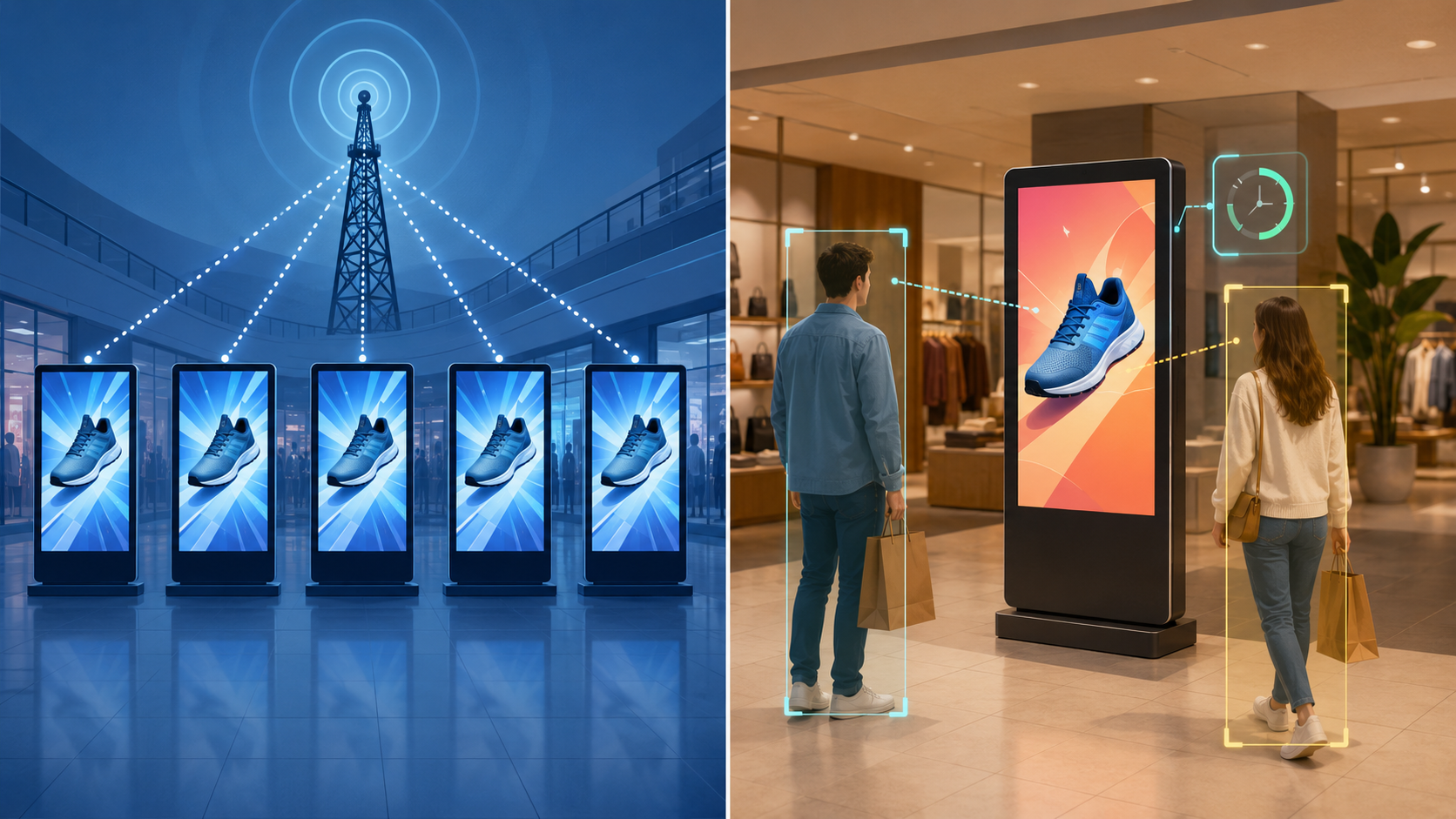
As great as Claude and ChatGPT are, cloud AI is not a solution for this problem. Thousands of screen installations cannot afford also installing an internet connection - and the response time to and from the cloud just isn’t fast enough. And then there’s the privacy and regulatory concerns.
No. Edge AI is the answer that digital signage has been waiting for.
What “Edge AI” Actually Means (Not the Hand-Wavy Version)
I want to be specific here, because I’m tired of people in this industry saying “AI at the edge” and meaning “we added a recommendation widget” without really talking about the edge.
To me, edge AI means continuously running sensor inputs — cameras, microphones, presence sensors — through an AI model, locally, in real time, to produce decisions or analytics without a cloud round-trip. These are models doing real work, constantly. Sustained compute workloads. Not a batch job. Not an occasional API call. A model running every frame, every second, for years.
We all experience this in consumer form: Siri, Alexa, Google Assistant. Automated license plate readers on toll bridges. That same capability is now moving into signage. A screen that can count how many people are in the queue. A kiosk that knows you made eye contact with the promotion. A display that shifts content based on the demographic context in the room. All locally. All privately.
But adding AI is just window dressing if the underlying media player can’t do its core job - and especially if you are just layering the AI tasks on top of what it’s already trying to do. If we really expect media player AI at the edge, there’s a set of capabilities that aren’t optional. Let’s talk about the problems we have to solve.
Why PCs Are (Still) a Disaster Waiting to Happen
I tried using PCs for edge AI at PRN. Thousands of them. It was terrible. Let me count the ways.
Moving parts die. Fans die — not if, when. In a retail cabinet that hits 50°C in July, that fan has a finite life measured in months, not years. Power supplies designed for office hours die when you run them 24/7 for three years. Motherboard capacitors designed for 25°C ambient environments age badly in 40°C equipment closets. And when those capacitors pop, that PC is dead. Roll a truck to replace it.
But the deeper problem isn’t technical. It’s philosophical. PC operating systems are designed from the ground up assuming a human is present if things go wrong. Blue screen of death? Reboot and call IT. Driver update conflict? Open Device Manager. Background process consuming 40% of CPU at 3am? That’s just Windows Update. Fine in an office. Catastrophic on a display at JFK Terminal 4 at 6am with no one there to press a button. And the button is locked inside an enclosure anyway.
I am certain you have all seen the blue screen of death on a screen in an airport or shopping mall. That is a PC in an environment it was never designed for, running software that expected someone to be watching. Nobody is watching. The screen just sits there, blue and embarrassing, until someone notices and drives to the location.
That’s not an edge case. That’s the architecture.
Oh, and forget about secure boot. It’s a PC, of course you can change the OS! Meaning you now have to be sure some script kiddie didn’t install something that plays… say, inappropriate content. Yeah. That’s not something you want in a mall, or a fast food restaurant.
Why Android Falls Apart at the Seams
Android feels like the obvious answer. Cheap, ubiquitous, ARM-based, lots of developer tooling. I get the appeal. Hell, I tried to use Android for signage at PRN!
Here’s the problem: Android OEMs ship a device at a specific Android version, it goes into production, and within two years — often less — the platform stops receiving security updates. The hardware still runs. But the CVEs for that older Android are stacking up. On a device connected to cameras, potentially to local databases, maybe to point-of-sale or inventory systems.
That’s not a theoretical risk. That’s Android’s actual track record in commercial deployments. Full stop. If you are considering an Android media player I encourage you to do a pen test on it. Go ahead. I’ll wait. Oh, you are terrified? Me too.
Then there’s the power management problem. Android’s power management is aggressive by default — it’s designed for a phone that needs to preserve battery life. That power management fights inference workloads constantly. The OS is making decisions you didn’t authorize, trimming clocks, suspending processes, managing thermals based on consumer assumptions. If you want to do AI at the edge on that device you will find that your inference pipeline gets unpredictable exactly when you need it to be reliable.
And there’s no guaranteed secure boot. It’s optional, inconsistently implemented by OEMs, and you have no way to know from the outside whether the device you just deployed has an enforced boot chain or a soft suggestion of one. Try explaining that to a CISO. We are right back to the same security concerns.
Why Windows Is the Wrong Answer for a Different Set of Reasons
Windows avoids the abandonment problem, I’ll give it that. Microsoft will patch Windows for years. But Windows is designed for a general-purpose desktop environment where background services are expected, IT staff are assumed, and the update model is designed around a human who can defer and decide.
None of that is compatible with a sustained, predictable inference workload running in an unattended commercial installation. Windows background services will compete with your inference pipeline. The attack surface — enormous for a general-purpose OS — requires ongoing management overhead that doesn’t scale across a fleet of tens of thousands of devices. And you’re paying $50–$150+ per device in licensing, plus the IT infrastructure to manage it all.
Windows adds significant operational overhead to what is fundamentally an appliance deployment. None of that overhead is free, and most of it doesn’t improve the customer experience.
Why (Most) Smart TVs Are the Worst of All Worlds
There are several large vendors that sell a version of a SmartTV aimed at digital signage. That makes some business sense for them, since they can leverage the development costs of the playback platform across their entire consumer base. But it also means that the core platform is based on the same consumer product. Are you happy with your three year old SmartTV and how responsive it is? How fast does it load Netflix? Yeah, you get my point. Those screens are underpowered when they are first launched and they don’t age well.
So how are those going to run AI? Probably not. Maybe they newest models coming out next year.
But there’s another, deeper problem: firmware updates. Not many models allow you to even upgrade the firmware. Nearly none of them support a remote over-the-air (OTA) update. A handful of models allow an on-site firmware update, but “on-site” means rolling a truck, touching every screen, one at a time. You know what that costs at 10,000 locations. Hoo boy. That’s expensive.
You go down that path and soon you will have a fleet running a three-major-version-old OS, with no practical remote remediation path, accumulating CVEs while your AI inference workload depends on a platform the vendor has effectively frozen. That is not a risk. That is a scheduled incident.
And some of those platforms build a proprietary CMS lock-in on top of all of that. Do you really want to be the signage operator who is now dependent on one display manufacturer across their entire estate. One supplier. No leverage. Locked into aging capabilities that started life underpowered. No thanks.
What Continuous Inference Actually Requires
Let me be concrete about the actual requirements. These aren’t preferences. These are the things without which your AI digital signage deployment will fail, degrade, or worse, get you fired.
A dedicated NPU. You cannot run continuous inference on CPU or GPU cycles that are already busy with video decode and display driving. You need purpose-built inference silicon with predictable, sustained throughput. The thermal math alone makes this mandatory: a dedicated NPU runs under four watts for sustained inference. Run that same workload on the CPU and you’re burning multiples of that, generating heat, throttling clocks, degrading inference accuracy during peak load. In July. In a drive-through. When it matters most.
A controlled OS. The moment your operating system starts making decisions you didn’t authorize — power management trimming clocks, a background service restarting, a security daemon consuming fifteen percent of compute at 3am — your inference workload is unpredictable. The OS must be purpose-built and answerable to the operator, not to its own internal scheduler designed assuming that a human is around - or worse, doing things at times it expects the human to not need it.
Thermal discipline. An AI player isn’t doing a short burst of work. It’s at sustained load, in an enclosed space, for years. The thermal design must be built around that assumption from the beginning. Not retrofitted. Not “good enough for most use cases.” Designed for it. Electronics running at thermal levels they weren’t designed for shave years off their useful life, and inference throttling is the first failure mode — long before the hardware actually dies.
Long OS support lifecycles. A deployment that goes in today will be running in five to seven years. The security patch pathway and the model update pathway both depend on OS stability. Android’s 18-month to two-year effective patch window isn’t anywhere close to sufficient. You need a vendor who owns the OS and commits to supporting it for the life of the deployment.
CISO-grade security. An edge AI player connected to cameras and local databases is not the same risk profile as a player showing a video loop. Secure boot from hardware root of trust. Controlled software supply chain. Minimal attack surface. Free device management with no third-party MDM required. These are the questions I get in enterprise conversations now, and they’re not optional.
Think about all this for a minute. You can have all the AI model sophistication in the world and still get garbage out if the fleet it’s running on just isn’t up to the task. That’s not a problem you can fix later in software.
BrightSign’s Answer
Disclaimer: Everything in this section is my personal opinion. I’m a VP at BrightSign, but I’m not speaking for the company here. These are my own views based on my own experience. BrightSign has reviewed this post for accuracy but has not changed the tone or content otherwise.
That said, the reason I took this role at BrightSign is specifically because I used BrightSign players in production in the past and have watched how the company continued to improve over the years - and I wanted to contribute to making that even better.
BrightSignOS — The Answer to All the Problems Above
BrightSignOS is purpose-built for commercial signage and edge compute. No background services making autonomous power management decisions. No consumer update frameworks pulling changes without operator authorization. No general-purpose application layer introducing unpredictable compute load. Just a rock-solid appliance with world-class AV capabilities - that also happens to be an Edge AI appliance.
And critically: BrightSign controls the update lifecycle. We’re not dependent on a consumer platform vendor whose priorities are elsewhere. Our players carry a five-year warranty, and we ship firmware updates frequently - and for five years after the last unit of each model ships — which in practice means support runs well beyond five years for most of the fleet. When we ship a firmware update, it applies consistently across every unit in a fleet — not conditionally, not depending on OEM configuration or carrier approval or whether the device made an approved list. And we have tools to help you manage those upgrades.
Compare that to Android: OEMs ship at a specific version, hardware goes into production, two years later no more patches. Compare it to Windows: staying current requires IT infrastructure, driver management, ongoing overhead. Compare it to SmartTVs: shipped three major versions behind, tied to display lifecycle.
BrightSignOS supports approximately 140 CMS platforms. The ecosystem standardized on our hardware not because we negotiated exclusives but because we built something reliable enough that CMS vendors wanted their software to run on it. That open ecosystem is the right model for enterprise. Operators retain choice across the stack. No vendor lock-in via proprietary software. That relationship only works if the execution layer is trustworthy, and we’ve spent twenty years making it so. I bought thousands of them back in 2009, and if I was planning a deployment today I would not even consider anything else.
And that’s before I talk about the AI at the Edge capabilities.
Let Me Start With What’s Actually Running in the Field Today
I get skeptical when companies talk about AI in signage and mean a roadmap slide. So let me start with what is actually running on our Series 5 and Series 6 hardware today. Some of what we have running:
- Real-time person detection, including motion and dwell time data.
- Gaze detection - how many people looked at the screen? For how long?
- Dwell time measurement, entry and exit counting, and queue length.
- Object detection - changing playback instantly when the desired object is detected
All running locally, all generating aggregate analytics, no images leaving the player. At 25–30 frames per second, fully on-device, at under four watts of additional incremental power consumption. Seriously. The inference is happening on the device and only aggregate outputs — counts, durations, attention rates — leave. No raw video going anywhere. Privacy is preserved.
Oh, and all that runs on our least powerful player - in 1 TOPS of NPU power. Our more capable players have 6 TOPS, giving a lot of room for added capability. We even have a basic LLM running simultaneously with the examples above. It’s more of a “small language model” but with a local RAG database it’s amazingly good for a standalone kiosk that can answer questions in regular language. The capability is there.
And here’s the part that matters beyond BrightSign specifically: the AI inference stack on our hardware is open source. Not “open source with an asterisk.” Actually open. The frameworks, the model pipeline, the integration APIs — available for any developer, any CMS partner, any customer to build on. We did that deliberately. We have 140+ CMS partners and we’re not going to build a walled garden and tell them to stay out. Every one of those partners gets the same access to the NPU, the same APIs, the same inference capabilities. If you’re a CMS vendor, an integrator, or a developer building something on top of BrightSign hardware, the AI infrastructure is yours to build on. That’s the whole point.
The Privacy Story Is Architecture, Not Policy
The use cases with real commercial value — audience analytics for retail media, impression measurement, attention tracking for content optimization — are exactly the use cases that run into serious regulatory trouble if they involve sending data to the cloud. On-device inference sidesteps this structurally. If the model runs on the BrightSign player, processes frames locally, and the only thing that leaves the device is aggregate output — three people in the frame, average dwell time eight seconds, attention rate forty percent — then there is no personally identifiable data crossing any network boundary. No biometric data in transit. No image stream to a cloud endpoint.
TCO — The Player Is Not the Cost You Should be Looking At
There’s a framing problem in how enterprise buyers evaluate this. The player is one of the biggest visible line items at purchase time. But VDC Research puts player cost at 4.6 to 5.5 percent of total deployment cost. The majority of the cost — the actual Total Cost of Ownership — is installation, integration, content, and ongoing management.
That changes the math.
The five-year warranty on BrightSign players is also a TCO factor. Maintenance and replacement costs can exceed the original player cost over a deployment lifetime. A player under a five-year warranty, designed and tested for the thermal conditions of the deployment environment, is a fundamentally different cost profile than general-purpose hardware that was never designed for sustained commercial operation. It’s the industry’s longest standard warranty. That’s not a marketing gesture — it’s what happens when you’re genuinely confident in the thermal and component design. We know how few RMAs we get - and we back that up with a 5 year warranty.
The Hardware/Software Debate Is a False Frame
I’ve been in a lot of conversations in this industry where hardware and software vendors talk past each other. The software side says hardware is commodity. The hardware side says you need their platform. Both sides are optimizing for their position rather than asking what customers actually need.
Bluntly stated: digital signage deployments don’t need commodity hardware. They need hardware suitable to the task at hand, and they need software suitable for the task at hand. It’s both.
As you probably have read in some of my other writings, AI-agentic development is drastically changing the way software is built. It’s tremendously exciting. I predict there will be major advances in CMS platforms - especially ones that tackle the problem of how to guide AI at the Edge!
Conclusion: The Screens Are Starting to Pay Attention
Three years from now, a well-run, modern BrightSign deployment is going to look something like this:
The central management system understands the fleet the way an experienced operations director understands their team. An operator says what they want — in natural language — and the system figures out how to do it, does it, checks its own work, and reports back. Routine operational work that currently requires a trained person looking at dashboards gets handled autonomously.
At each player, the device understands its immediate environment. Who’s in front of it. The content history for this location. What’s available in content inventory. What time and context it’s operating in. It selects from an approved library within brand framework, runs the selection locally and privately, and surfaces anomalies — a display issue, a content gap, a thermal trend — before they become problems.
Content creation is automated. Advertisers and Marketers can use plain language to describe the media they want, and Ai agents create it - all according to brand guidelines and appropriate constraints (which may start life as templates).
The network as a whole learns. Every interaction, every audience measurement, every operational event feeds back into models that make the next decision better.
That’s not science fiction. The hardware exists — shipping today, with dedicated NPUs on every player. We are building the future with this, and would love to have you as a partner.
The screens are going to start paying attention. I’m glad we spent years making sure the infrastructure was worth trusting them with.
*Want to talk about what edge AI actually looks like on deployed hardware? I’m at gherlein@brightsign.biz — always happy to get into the specifics with people doing real deployments.