Last time I worked out the comms half of my whale project - 900 MHz ISM radio to get the audio across the Bay of Banderas, no satellite, no cloud. But comms is only half. Something on the water still has to decide what’s worth sending. That’s the brain. And it turns out my day job already built it.
Same disclaimer as always: personal project, my employer has nothing to do with it, done in my sparse spare time.
Where things actually stand
Quick catch-up, because a lot has moved. I returned the SOFAR Spotter over the data-ownership terms. I got my ham license (KO6HAX). My son Luca and I pivoted the whole thing to a human-in-the-loop drone instead of an unattended buoy, because the permits actually work that way. And I sorted the radio link home.
So the node has power. It has a way home. What it doesn’t have yet is a brain.
The brain is the hard part now
Here’s the thing I kept skipping. Even with a nice 900 MHz pipe, you can’t stream raw hydrophone audio all day - not over that link, not on a drone’s power budget. The node has to listen, decide “that’s a whale,” and only then move the clip worth moving. Everything else stays local and gets thrown away.
That’s on-device inference. And that’s literally what I do at work now.
I’ve spent two years building edge AI on NPU hardware - Argus and the whole repo family, and lately a multi-camera person detector that runs entirely on-device and spits results out over MQTT. Swap “person on a camera frame” for “song in an audio window” and it’s the same machine: run the model locally at a few watts, never ship the raw stream, emit a tiny structured event. Detection at the edge, dumb network.
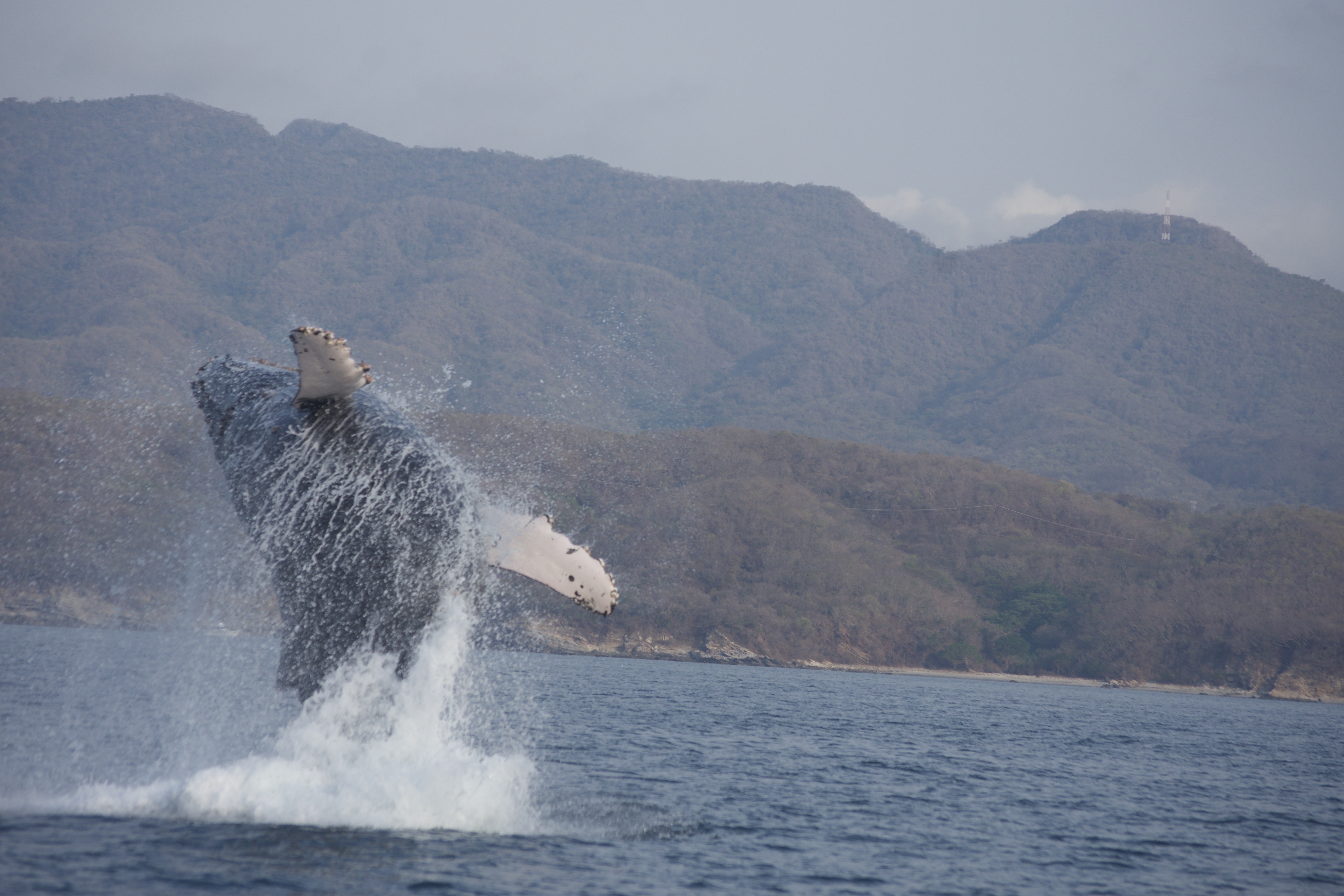
A humpback breaching in the Bay of Banderas. The whole point. Photo by Greg Herlein.
It fixes the exact worries I had back when this was a buoy. An NPU does real work at a few watts, so the power budget closes. Only the good clips cross the radio, so the data problem shrinks. And scientists already have thousands of hours of recordings - the bottleneck was never recording more, it was finding the signal in real-time. On-device classification is how you find the needles instead of hauling home the whole haystack.
The real focus now: the AI, not the box
So here’s where my head is at. I’ve spent way too long on where this thing lives - buoy, Spotter, drone, radio, power budgets. All of that is hosting. And hosting is a distraction from the one question that actually decides whether any of this is real:
Can a tiny NPU actually detect whale song?
I don’t know yet. Probably! Almost certainly! But I can’t answer it by buying more hardware. I answer it with data and a model, on my desk, completely independent of how it eventually gets hosted on the water. The good news is I don’t need to go record anything to start - scientists already have thousands of hours of whale song sitting in public archives. So the next real work is: pull those recordings, build an audio classifier, and then see if it still runs when I squeeze it down onto a little NPU at a few watts. Oh, and yes, get some recordings of my own this winter to ensure that the gear I can afford to record with will get good enough data.
These are clean, self-contained experiments. Does the model work at all? Then: does it still work tiny? On data I can collect? If all are yes, the whole project is actually plausible. If any are a “no”, I learn that now - cheap, dry, on my desk - instead of after I’ve bolted something to a drone.
What’s next
Shrink the first step until it’s dumb-easy - same way every repo in the Argus family started as one tiny “can I even do this?” experiment. Not “build the drone.” Just: grab archived recordings, train a whale/not-whale detector, get it running on a tiny NPU, and fire one MQTT event when it hears something. In Go where we can. The box can wait - prove the brain first.
The whales come back to Banderas Bay every winter, and another season’s nearly here. Natural deadline. I’ll be there in a few weeks. Stand by.
If you’ve built anything with edge audio classification, hydrophones, or small marine robots - or you want to poke holes in the plan - drop me a note on LinkedIn. Especially if you’re a scientist who could use the data.